My research interests focus on Human-Centered Computing, with the goal of understanding and modeling human behavior and societal dynamics influenced by technology. I employ a mix of methods, such as interviews and ML, to explore these dynamics from various perspectives, including industrial structures and social media. Ultimately, I aim to contribute to the development of technology that positively impacts society.
At ShanghaiTech, I am a research intern in ViSeer LAB supervised by Prof. Quan Li, where I actively participate in research projects on HCI, Data Visualization, and Social Computing.
I am also a crazy fan on histroy and strategy games like Paradox, enjoying Europa Universalis IV!
My first first-author full paper SCSimulator: An Exploratory Visual Analytics Framework for Partner Selection in Supply Chains through LLM-driven Multi-Agent Simulation has been formally accepted by IUI 2026! Huge thanks to my supervisor Prof. Quan and all co-authors for their support and guidance throughout this journey!
Jan 15, 2026
My co-first-author full paper CommSense: Facilitating Bias-Aware and Reflective Navigation of Online Comments for Rational Judgment has been conditionally accepted by CHI 2026! Congrats to Yang Ouyang and Prof. Quan!
Jan 12, 2026
My first first-author full paper SCSimulator: An Exploratory Visual Analytics Framework for Partner Selection in Supply Chains through LLM-driven Multi-Agent Simulation has been formally accepted by IUI 2026! Huge thanks to my supervisor Prof. Quan and all co-authors for their support and guidance throughout this journey!
Aug 03, 2025
Our demo QueryGenie: Making LLM-Based Database Querying Transparent and Controllable has been accepted by UIST 2025 demo track! Congrats to Longfei and Prof. Quan!
Mar 16, 2025
Influence Maximization in Temporal Social Networks with a Cold-start Problem has been accepted by ICWSM 2025!
Supply chains (SCs), complex networks spanning from raw material acquisition to product delivery, with enterprises as interconnected nodes, play a pivotal role in organizational success. However, optimizing SCs remains challenging, particularly in partner selection, a key bottleneck shaped by both competitive and cooperative dynamics. This challenge inherently constitutes a multi-objective dynamic game requiring a synergistic integration of Multi-Criteria Decision-Making (MCDM) and Game Theory (GT). Traditional approaches, grounded in mathematical simplifications and managerial heuristics, often fail to capture real-world intricacies and risk introducing subjective biases. Multi-agent simulation (MAS) offers promise, but prior research has largely relied on fixed, uniform agent logic, limiting practical applicability. Recent advances in Large Language Models (LLMs) create new opportunities to represent complex SC requirements and hybrid game logic. However, challenges persist in modeling dynamic SC relationships, ensuring interpretability, and balancing agent autonomy with expert control. To address these issues, we present SCSimulator, an exploratory visual analytics framework that integrates LLM-driven MAS with human-in-the-loop collaboration for SC partner selection. SCSimulator simulates SC evolution via adaptive network structures and enterprise behaviors, which are visualized via interpretable interfaces. By combining Chain-of-Thought (CoT) reasoning with explainable AI (XAI) techniques, the framework generates multi-faceted, transparent explanations of decision trade-offs. Users can iteratively adjust simulation settings to explore outcomes aligned with their expectations and strategic priorities. Developed through iterative co-design with SC experts and industry managers, SCSimulator serves as a proof-of-concept, offering both methodological contributions and practical insights for future research on SC decision-making and interactive AI-driven analytics. Usage scenarios and a user study further demonstrate the system’s effectiveness and usability.
@inproceedings{10.1145/3742413.3789061,author={Gao, Shenghan and Wang, Junye and Xiong, Junjie and Jiang, Yun and Fang, Yun and Hu, Qifan and Liu, Baolong and Li, Quan},title={SCSimulator: An Exploratory Visual Analytics Framework for Partner Selection in Supply Chains through LLM-driven Multi-Agent Simulation},year={2026},isbn={9798400719844},publisher={Association for Computing Machinery},address={New York, NY, USA},url={https://doi.org/10.1145/3742413.3789061},doi={10.1145/3742413.3789061},booktitle={Proceedings of the 31st International Conference on Intelligent User Interfaces},pages={1602–1624},numpages={23},keywords={Multi-Agent Simulation, Visual Analytics, Supply Chain Management},location={
},series={IUI '26},}
CHI
CommSense: Facilitating Bias-Aware and Reflective Navigation of Online Comments for Rational Judgment
Yang Ouyang*, Shenghan Gao*, Ruichuan Wang, Hailiang Zhu, Yuheng Shao, Xiaoyu Gu, and Quan Li
In Proceedings of the 2026 CHI Conference on Human Factors in Computing Systems, , 2026
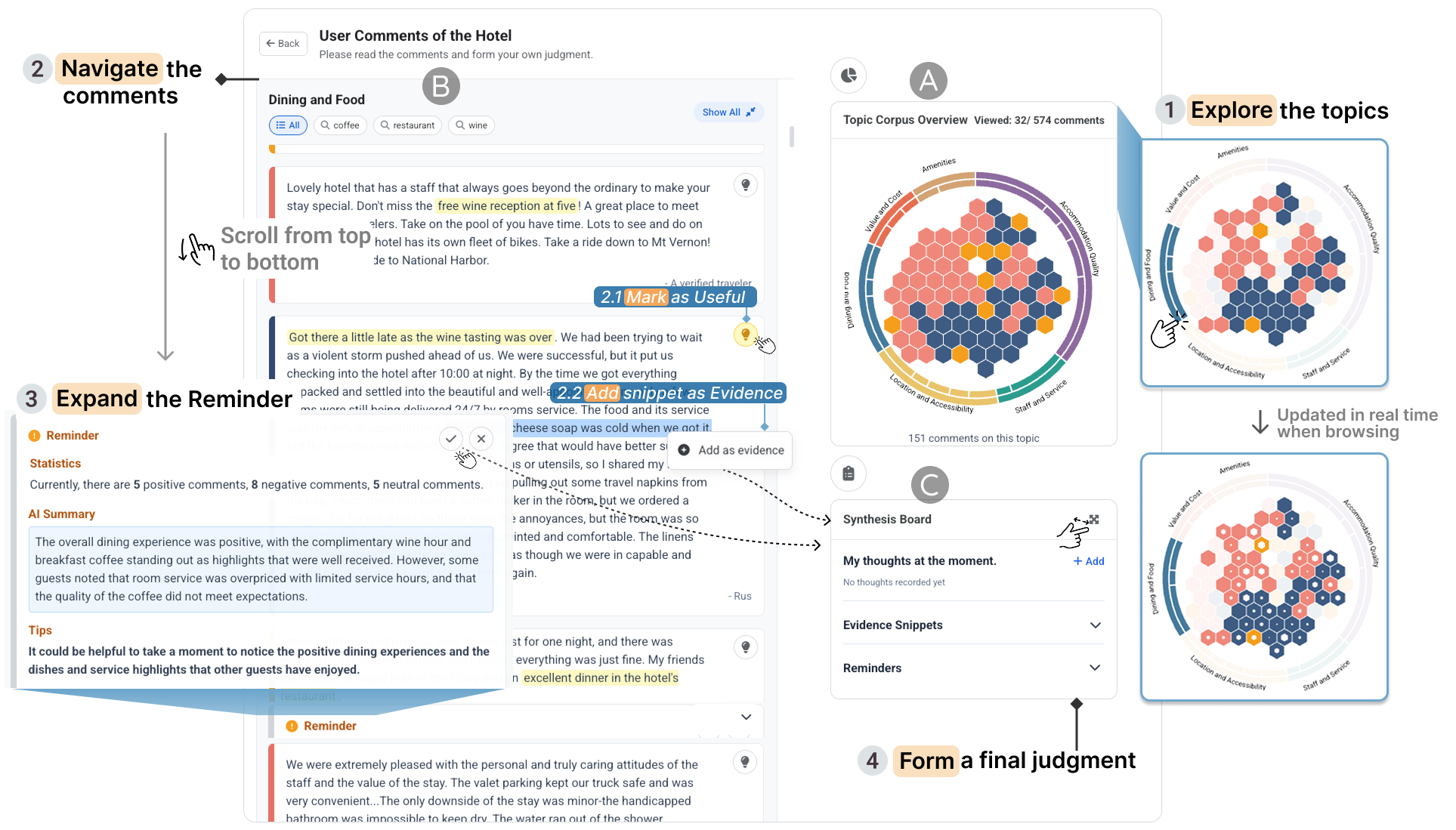
Online comments significantly influence users’ judgments, yet their presentation, often determined by platform algorithms, can introduce biases, such as anchoring effects, which distort reasoning. While existing research emphasizes mitigating individual cognitive biases, the evolution of user judgments during comment engagement remains overlooked. This study investigates how presentation cues impact reasoning and explores interface design strategies to mitigate bias. Through a preliminary experiment (N=18) and a co-design workshop, we identified key challenges users face across a four-stage process and distilled four design requirements: pre-engagement framing, interactive organization, reflective prompts, and synthesis support. Based on these insights, we developed CommSense, an on-the-fly plugin that enhances user engagement with online comments by providing visual overviews and lightweight prompts to guide reasoning. A between-subject evaluation (N=24) demonstrates that CommSense improves bias awareness and reflective thinking, helping users produce more comprehensive, evidence-based rationales while maintaining high usability.
@inproceedings{10.1145/3772318.3790530,author={Ouyang, Yang and Gao, Shenghan and Wang, Ruichuan and Zhu, Hailiang and Shao, Yuheng and Gu, Xiaoyu and Li, Quan},title={CommSense: Facilitating Bias-Aware and Reflective Navigation of Online Comments for Rational Judgment},year={2026},isbn={9798400722783},publisher={Association for Computing Machinery},address={New York, NY, USA},url={https://doi.org/10.1145/3772318.3790530},doi={10.1145/3772318.3790530},booktitle={Proceedings of the 2026 CHI Conference on Human Factors in Computing Systems},articleno={484},numpages={30},keywords={Online Community, Information Seeking, Bias Awareness},location={
},series={CHI '26},}